

If you ask a true Florentine what the city’s most important monument is, they might say the Duomo. But if you ask them at lunchtime, the answer will be immediate: the Trippaio’s stand. Lampredotto is not just street food; it is a secular ritual, a bastion of resistance against global fast food.
Many confuse it generically with “tripe“, but that is an unforgivable anatomical and gastronomic error. Lampredotto is the abomasum, the fourth stomach of the cow. It is the most delicate part, composed of a lean section (the gala) and a fatty section (the spannocchia). The magic of this sandwich lies in the chemical balance between the gelatin released during cooking, the savory punch of the Salsa Verde, and the spongy texture of the “semelle” bread.
In this article, I won’t just give you the recipe. I will explain scientifically why the bread must be dipped only on top, how to get meat that melts in your mouth without falling apart, and how to prepare the Green Sauce that cleanses the palate with every bite.
In this article:
History and Curiosities: From Lampreys to Trippai
In the Renaissance, wealthy lords feasted on lampreys, highly prized and expensive freshwater fish that abounded in the Arno river. The common people, who could not afford them, noticed that the shape of the boiled abomasum, with its curled ridges, resembled the mouth of those fish.
Thus “lampredotto” was born: the illusion of luxury on a poor man’s plate. The Trippai (tripe sellers) are an institution as old as the city itself; in the 15th century, they were already organized in guilds and had their shops on the Ponte Vecchio, before being “evicted” by the Medici family, who preferred the smell of gold to that of boiled offal.
Identikit of the Ingredient: Abomasum and Collagen Reaction
Why is Lampredotto so different from classic tripe? It’s all in the structure. The abomasum is rich in connective tissue and collagen. Slow cooking (simmering) at about 90-95°C (195-200°F) allows the collagen to hydrolyze, transforming into gelatin.
If it boils too hard, the muscle fibers harden, and the meat becomes tough. If it cooks too little, it remains rubbery. The secret is to keep the broth in a perpetual, gentle shudder. Furthermore, the bread must strictly be a Rosetta or Semelle: its “hollow” structure and thin but crunchy crust are designed to absorb the liquid without disintegrating instantly.
Recipe Card
| Prep Time | 30 minutes |
| Cook Time | 2 hours (if pre-cooked) / 4 hours (if raw) |
| Total Time | 2 hours and 30 minutes |
| Difficulty | Medium (requires sensitivity) |
| Cost | Low |
| Servings | 4 Generous Sandwiches |
Ingredients
- For the Lampredotto:
- 1 kg (2.2 lbs) of Lampredotto (abomasum – possibly already cleaned and pre-cooked)
- 2 Large golden onions
- 2 Carrots
- 2 Stalks of celery
- 4-5 Peeled tomatoes (or a tablespoon of tomato paste)
- A bunch of parsley (stems included)
- Coarse salt and Black pepper
- For the Panino and Sauce:
- 4 “Semelle” or Rosetta rolls (fresh)
- Tuscan Salsa Verde: parsley, desalted capers, anchovies, bread crumbs soaked in vinegar, 1 hard-boiled egg, EVOO, garlic.
- Spicy oil (optional but recommended)
The 3 Commandments of the Lampredotto
To avoid being banned from Florence, you must respect these three sacred laws:
- Eaten only in a bun (mostly): Lampredotto on a plate (“in zimino”) exists, but its true destiny is in the semelle roll. Do not use sliced bread, baguettes, or ciabatta. You need the Rosetta.
- The “Inzuppata” is mandatory: The top part of the bun MUST be dipped briefly into the hot cooking broth. If the bun is dry, it is not a Lampredotto.
- Salsa Verde, not Mayonnaise: Asking for mayonnaise or ketchup on lampredotto is grounds for immediate excommunication. The acidity of the green sauce serves chemically to balance the fattiness of the spannocchia.
Step-by-Step Recipe
The Mother Broth. Fill a tall pot with plenty of cold water. Add the onions, carrots, celery, and tomatoes (whole or in large chunks). Bring to a boil and add a generous pinch of coarse salt. This is not a broth to be thrown away; it will become the liquid gold of your sandwich.

The rich broth simmers slowly. The scent of Florentine tradition. Slow Cooking. Immerse the lampredotto (whole, not cut!) into the boiling broth. Immediately lower the heat to a minimum. It must simmer gently covered for at least 1.5 hours (if pre-cooked) or up to 3-4 hours if raw. The meat is ready when a fork enters the gala without resistance, like butter.

In the old aluminum pot, lampredotto simmers for hours in its rich aromatic broth. The Green Sauce (While boiling). Finely chop parsley, garlic, capers, and anchovies with a knife (avoid the blender if possible so as not to heat the blades). Add the bread crumbs (previously soaked in red vinegar and squeezed dry) and the crushed hard-boiled egg yolk. Emulsify with plenty of EVOO until you get a rustic and fragrant cream.

The green sauce, roughly pestled by hand, vibrant with parsley, garlic, and capers in good oil. The Master’s Cut. Remove the hot lampredotto from the broth and place it on the cutting board. With a very sharp knife, slice it into thin, irregular strips. You will notice the difference in texture between the dark, curly part (gala) and the light, soft part (spannocchia). Salt and pepper generously on the cutting board.

Cutting the Lampredotto. Sliced hot on the old worn cutting board. Steam, tenderness, salt, and pepper. Assembly and “The Dip”. Cut the bun in half. Slightly hollow out the bottom crumb if excessive. Place a mountain of hot lampredotto on the base. Season with a spoonful of green sauce (and spicy oil if you like). Now the sacred gesture: take the top crust of the bread with a fork or tongs and dip it quickly into the hot cooking broth. Close the sandwich. Eat immediately.

The Lampredotto sandwich. A mountain of hot, succulent meat, immediately crowned by a generous spoonful of green sauce. 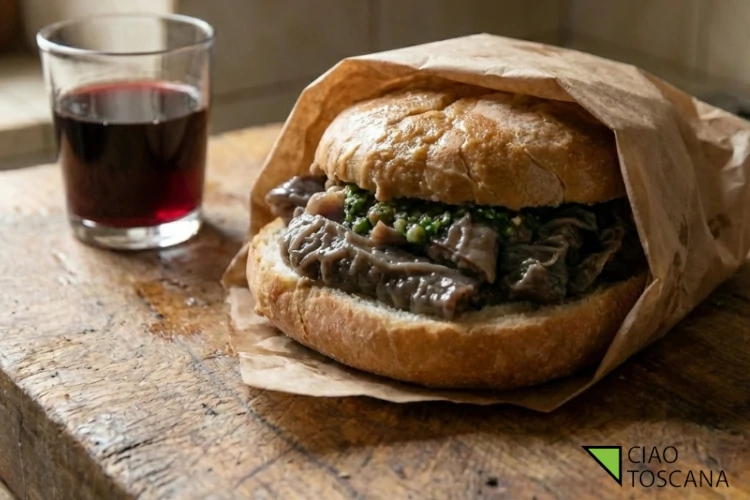
The Lampredotto sandwich
FAQ – Frequently Asked Questions
What is the difference between tripe and lampredotto?
Common tripe (often “foiolo” or honeycomb tripe) comes from the cow’s first three stomachs. Lampredotto is exclusively the fourth stomach (abomasum), which is darker, more flavorful, and gelatinous.
Can it be frozen?
Yes, you can freeze cooked lampredotto immersed in a bit of its broth. However, the sandwich must always be assembled with meat reheated in boiling broth at the moment of serving.
Where can I find lampredotto outside Tuscany?
Ask your trusted butcher for bovine abomasum. It is often discarded or used for pet food because there is little demand, but if you order it, they will likely save it for you.
Is it a fatty dish?
Less than you might think. The abomasum itself is lean meat; the fat is concentrated in the “spannocchia” which can be removed, but since it is boiled, part of the fat ends up in the broth. A sandwich has about 400-500 kcal, much less than a burger with fries.
